
Last updated on March 3rd, 2024 at 01:32 pm
If you are looking for hypoallergenic dogs for adoption, you may have come to the breed that results from a cross between a Poodle and a Golden retriever, but are Goldendoodles hypoallergenic? This question is answered perfectly in this post.
Being allergic to dog fur is really quite annoying, especially if you are a pet lover; for this reason, it’s essential to know if a breed is hypoallergenic or not, and that’s why we’ll give you a detailed guide to know about this, and much more.
READ MORE:
- Goldendoodles are a popular breed, but do you know when they stop growing and how big they can get? Find out in our comprehensive article.
- Looking to train your Goldendoodle? We’ve got you covered with top tips for care and training.
- What does F1B mean when it comes to Goldendoodles? Our comprehensive guide to the doodle will give you all the information you need.
Are Goldendoodles Hypoallergenic?
Yes, but also no. Goldendoodles are not 100% hypoallergenic dogs, and although, in most cases, they don’t shed a large amount of fur and dander, this will depend mainly on the generation we have in our home.
What do we mean by generation? Well, as you know, the Goldendoodles come from the crossbreeding of a Poodle with a Golden retriever, but, also, there are other Goldendoodles that derive from the crossbreeding of a Goldendoodle with a Poodle or two Goldendoodles. In fact, the only “pure” Goldendoodle is the f1 Goldendoodle, followed by the f1b Goldendoodle, the f2 Goldendoodle, the f2b Goldendoodle, and the multigene Goldendoodle.
When defining a Goldendoodle as hypoallergenic, you should know that the more Poodle genes the dog has, the more hypoallergenic it will be. Therefore, generations such as f1b (75% poodle) and f2b (62.5% poodle) will be highly hypoallergenic.
If you want to know what generation is your Goldendoodle? Find out in this post!
It’s also essential to consider the type of fur our Goldendoodle has, whether it’s straight or curly, analyzing its fall.
What does “Hypoallergenic” Mean?
The word “hypoallergenic”, which defines a dog or not, indicates that its fur will not present an allergic reaction in our body. The suffix “hypo-” is the opposite of “hyper-“, so it means ” low” or “below”, indicating that it doesn’t give allergies.
Generally, to be considered hypoallergenic, dogs must not have fur shedding, which is the main cause of allergies that many people have when approaching certain dogs in particular. Therefore, we conclude that dog fur allergy only occurs in dogs with shedding, so some generations of Goldendoodles are completely hypoallergenic.
Despite this, many consider that dog allergies are not caused by their fur but by their dander; like humans, many breeds shed fur because they have high levels of dander, which is dead skin, usually from the scalp.
Do Goldendoodles Lose a Lot of Hair?
Generally, Goldendoodles are not usually dogs that shed a large amount of fur, in case they do. As previously mentioned, this depends to a great extent on the generation we are talking about.
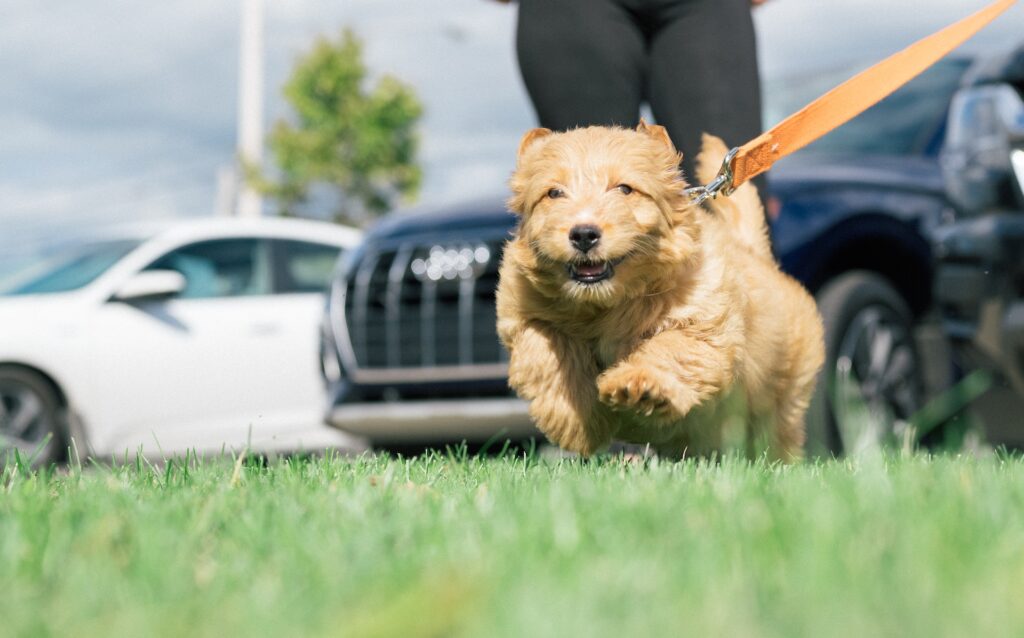
For example, the purest generation, i.e., f1 Goldendoodle, is the one that sheds the most, although it’s almost imperceptible. This is because it’s the generation with the most Golden retriever genes, which is a dog that tends to shed a lot of hair.
In comparison, other generations with more Poodle genes don’t shed any hair since this breed has curly fur that doesn’t usually undergo annual shedding, making it hypoallergenic.
For this reason, when you are going to adopt a Goldendoodle, make sure to check that it’s a generation with more Poodle genes, in case you are a person with an allergy to dog hair.
Which Generations of Goldendoodles Are Most Hypoallergenic?
As mentioned previously, some hypoallergenic Goldendoodle dogs shed and shed more fur than others, depending on the generation. For this reason, we’ll show you which generations of Goldendoodles are the most hypoallergenic.
- F1 Goldendoodle: This is one of the least hypoallergenic generations, i.e., the most harmful to people who suffer from allergies. This is because they have an equal percentage of Poodle (a hypoallergenic dog) and Golden Retriever (which sheds a lot of hair) genes.
- F1B Goldendoodle: This generation is the most hypoallergenic since it derives from the crossbreeding of an f1 Goldendoodle and a Poodle, so the latter’s genes are elevated up to 75%, which makes them perfect for people with allergies to canine hair.
- F2 Goldendoodle: The f2 Goldendoodle is just as hypoallergenic as the f1 Goldendoodle, i.e., almost nothing. This is because this dog derives from the crossbreeding of two f1 Goldendoodles, having 50/50 in Poodle and Golden retriever genes, being even more unpredictable than his parents. This is why it is considered a non-recommended dog for allergy sufferers.
- F2B Goldendoodle: The f2b Goldendoodle is quite hypoallergenic, although less so than the f1b Goldendoodle because it has 62.5% poodle genes, less than the 75% of its predecessor.
- Multigene Goldendoodle: Lastly, we find the multigene Goldendoodle, which includes the f1bb, f2bb, and f3 Goldendoodle. Generally, these are equally hypoallergenic dogs, as they are usually derived from the crossbreeding of two f1b Goldendoodles or higher.
What Causes Dog Allergies?
Many may think that if a dog sheds a lot of furs, it’s mainly due to its coat, but the truth is that this is more likely to happen through dog allergies, mainly in the skin.
The loss of fur is caused by weakness or damage to the scalp, with visible wounds that, as they heal, dry out and cause dandruff, which is precisely the problem that causes a dog to shed fur and which causes human allergies.
In short, and to summarize, your dog’s fur loss is due to dandruff, caused by an allergy in the scalp, mainly caused by poor nutrition.
In the following, we show you the best hypoallergenic dog food, which can help you avoid your pet’s fur loss.
Hypoallergenic Dog Food
Many dogs tend to shed fur or lose a large amount of their coat due to dandruff, as previously mentioned, which is an allergic reaction of their skin, often caused by the food they eat; for this reason, it’s vitally important that you check the food you give your dog.
If you are looking for hypoallergenic dog food, you can opt for Royal Canin Hypoallergenic, a food formulated under veterinary control and specifically for dogs suffering from skin allergies, which cause fur loss. They are easy-to-digest croquettes that don’t trigger allergic problems.
Another option from the same brand is the Anallergenic line, formulated for dogs with advanced allergies. It’s more commonly used in severe cases, so you must consult your veterinarian if it’s necessary or not to give this food to your dog.
If you want to opt for a more economical option, you have the option of Hill’s Canine, specifically the z/d Allergy & Skin Care line. It’s a food formulated in detail to improve your pet’s skin health, avoiding fur loss and, consequently, an allergic reaction from you or anyone who is allergic to canine fur.
How do I know if I am allergic to Goldendoodles? Allergy symptoms
You may not know whether or not you are allergic to Goldendoodles, particularly their fur. If you have sneezing, runny or congested nose, facial pain, coughing, chest tightness, difficulty breathing, wheezing, watery and red eyes, itchy eyes, or skin rash, you may be having an allergy to your dog or to a dog from a home you have recently visited.
To be sure in detail, we recommend that you go to a medical center and consult as soon as possible whether or not these symptoms are due to an allergy to canine fur.
How to Minimize Allergies to Goldendoodles?
If you have recently discovered that you are allergic to your Goldendoodle (and canine fur in general), it’s vitally important that you know how to act and what steps to take to reduce these allergies as much as possible.
A very useful method is to brush your Goldendoodle frequently with a special brush to remove all the loose hair and prevent it from falling out and floating in the environment, which is precisely what causes the allergy. This also helps to get rid of dust and pollen from our dog’s fur.
After brushing your Goldendoodle, you should remove the dust floating in the air with a feather duster. If possible, wait half an hour after brushing and cleaning the furniture, tables, beds, etc. This will help you remove the dust and pollen shed from the fur.
As well as the furniture, you should also vacuum the dust and fur residue left on the floor of your home. Another very useful method, complementary to brushing, to avoid allergies to our dog’s fur shedding is to take our Goldendoodle to a professional groomer every two or three months. This will significantly reduce dander and other allergens adhering to our dog’s fur.


